- Idea TBD.
- Posts
- Steal This Idea: Self-Healing Documentation
Steal This Idea: Self-Healing Documentation
A knowledge system that understands dependencies, detects impact, and fixes itself

The Problem
Your team's documentation is a mess, and you know it.
You update a feature spec, and suddenly three other docs are wrong. Someone changes the pricing, but the sales deck still shows the old numbers. A developer deprecates an API endpoint, and nobody updates the integration guide.
Every company has the same nightmare: docs that silently drift out of sync. Product specs contradict roadmaps. SOPs reference processes that no longer exist. Onboarding materials teach people the wrong way to do things.
Teams end up working with different versions of reality. And nobody notices until something breaks.
The Solution
What if your documentation could maintain itself?
Bindr is a smart workspace that automatically detects when documents depend on each other, propagates updates across your knowledge base, and alerts the right people when something changes.
Think of it as Notion with a brain. Or a living knowledge graph for your entire company.
When you edit one document, the system instantly knows what that change affects, which pages need updates, and who should be notified. Your documentation becomes self-healing.
Here’s what a simple version of Bindr could look like :
How It Works
The system builds a semantic knowledge graph of your entire workspace. Every doc, section, and block gets mapped and understood. So when you change your pricing in one place, it knows that pricing shows up in three other documents.
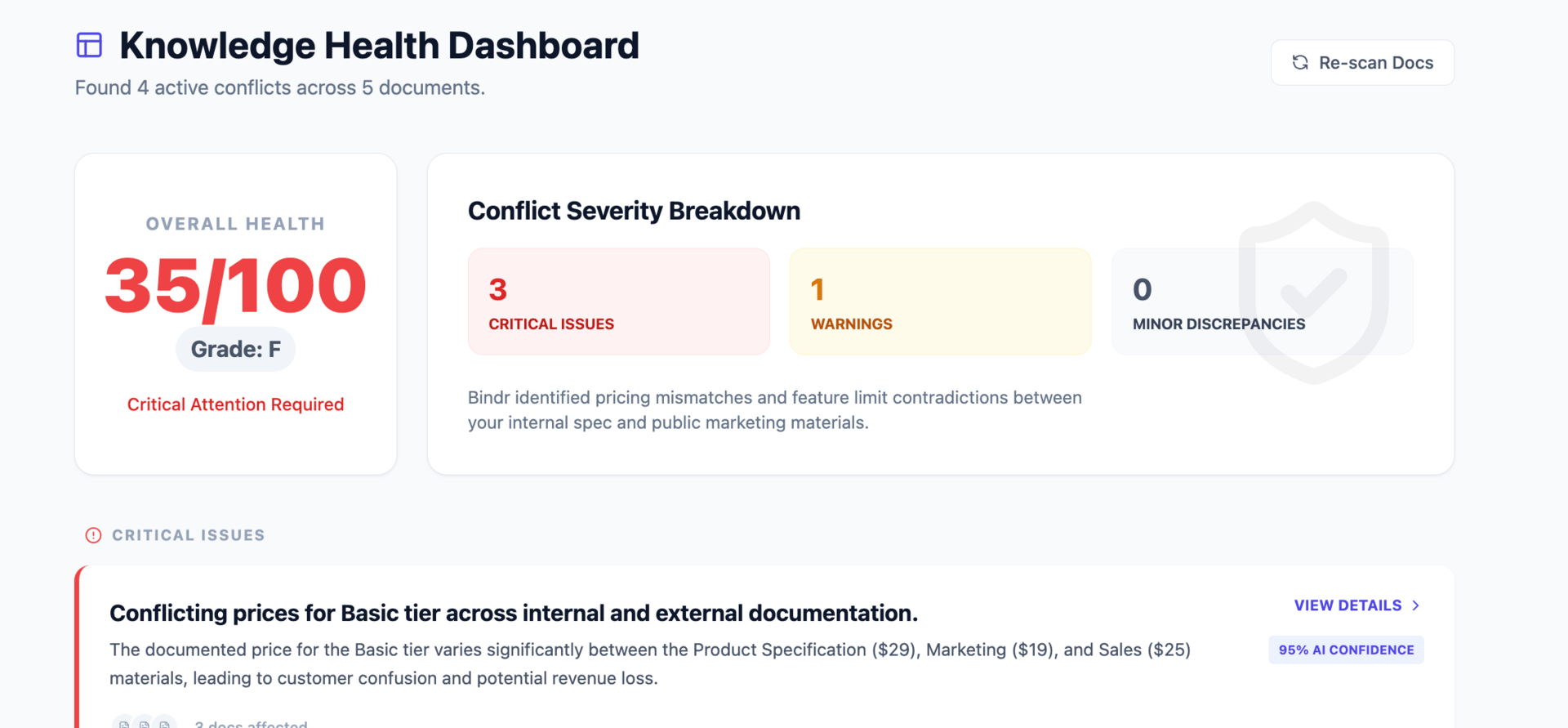
When content changes, a diff engine identifies what concepts were altered: pricing, rules, dates, features, whatever matters.
Then it runs impact analysis and surfaces the affected docs: "This change impacts your Paywall Spec, Marketing Copy, and Billing FAQ."
The AI generates suggested updates for those downstream docs. You can accept or ignore them with one click.
Smart notifications go only to relevant people, not the whole team. And for mirrored content like definitions or numbers, you can set up auto-sync rules so changes propagate everywhere automatically.
Who This Is For
Product teams dealing with PRDs, specs, and roadmaps that constantly go stale
Engineering teams managing deprecations, API changes, and architecture docs that need to stay consistent
Operations and compliance folks where accuracy isn't optional (SOPs, policies, legal pages)
Marketing and GTM teams who constantly find that product updates have broken their website copy and pricing pages
Early-stage founders who move fast and change things constantly, where documentation can never keep up
Agencies running tons of parallel client docs that are all interconnected
How to Monetize This
Core SaaS Subscription: Starter at $9-15/month for individuals, Team at $49-99/month, Organization at $299-499/month, and Enterprise at $1,000+ with SOC2, SSO, and audit logs
Usage Add-Ons: Extra AI suggestions, auto-sync blocks, advanced dependency insights, and an AI assistant trained on the entire workspace
Integrations: Plugins for Notion, Google Docs, and Confluence at $5-10 per user, or workspace-level pricing
Compliance/Enterprise Pack: Full audit trails, required-reading workflows, and change-approval flows
AI Agent Module: Autonomous agents that keep all documentation up-to-date. High-margin, optional upgrade that power users will pay for
The Takeaway
Documentation debt compounds faster than technical debt. Every outdated doc creates confusion, slows down decisions, and wastes hours of team time.
A self-healing documentation system isn't just a nice-to-have. It's infrastructure for how modern teams think and operate.
If this resonated, share it with a friend, a founder or even a cat. More ideas like this drop every week at IdeaTBD. :)
Reply